
There are a lot of moments right now when the world feels like a heavy place.
News of wars, crises, and uncertainty is suddenly no longer a distant concern but has become part of our everyday lives. And even as we go about our business, work, and live our daily lives, many of us feel something lingering beneath the surface: a quiet sense of unease. Sometimes it’s fear. Sometimes it’s a feeling of powerlessness. And sometimes it’s that elusive question of how things are going to turn out. Translated with DeepL.com (free version)
Not always loud. But often noticeable.
It is precisely in times like these that a very clear desire arises: to find inner peace.
Not because everything outside is calm—but because we need a place within ourselves that is.
What helps me isn’t withdrawing from the world, nor is it “gaining more knowledge.” It’s a shift in perspective—one that keeps bringing me back to what I can actually control.
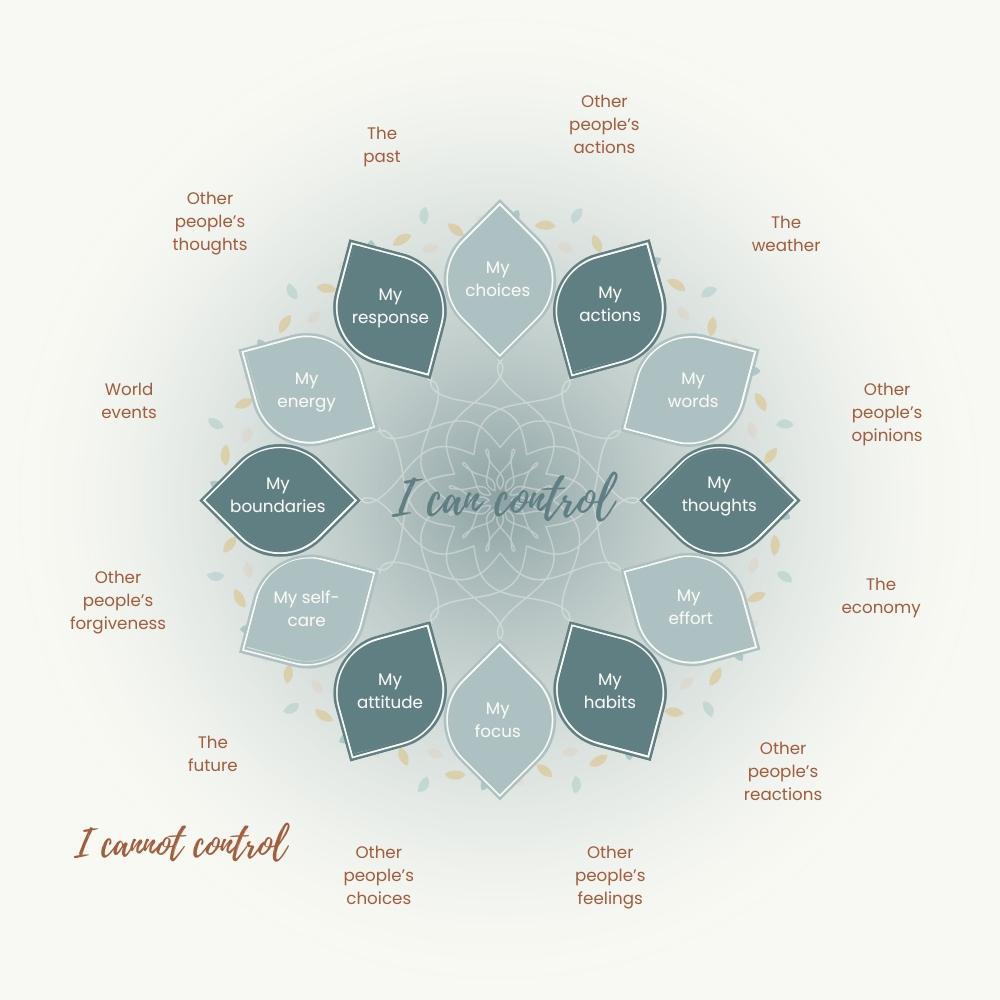
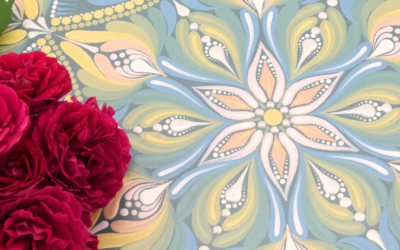
And that’s exactly why I picked this picture:
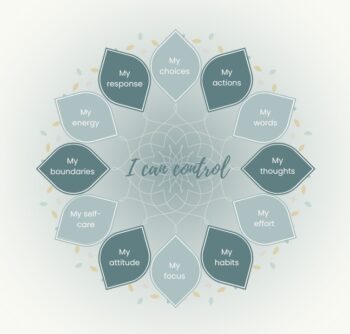
The Mandala of Control
The concept of the Circle of Control is not new. It dates back to Stoic philosophy, to Epictetus, and is as simple as it is liberating:
There are things you can control.
And then there’s everything else.
What happens in the world, how other people behave, what news reaches us – none of this is within our direct control. And yet we often spend an incredible amount of energy worrying about precisely these things.
I know that feeling all too well. That inner turmoil, that mental clinging to things that can’t be grasped – and yet still won’t let us go.
At some point, I realised: I need a picture for this.
This is how my Mandala of Control came into being. At its centre lies what belongs to me. Towards the outside, it becomes wider and more open – a space for everything I cannot control, but must simply let go of.
Not as a perfect solution. But as a guide I can always come back to.
Finding inner peace does not begin in the outside world
A mandala always has a clear centre. Everything else unfolds from there.
And that’s exactly how it feels.
At the heart of it all lies what you can truly control:
your thoughts, your reactions, how you treat yourself, your breath in this very moment.
The further you move away from it, the quicker that feeling of being driven takes hold. Of inner restlessness. Of powerlessness.
Finding inner peace does therefore not mean shutting out the world.
Instead, it means consciously returning to this centre again and again.
Why helplessness feels so real
What we often underestimate is that our bodies do not clearly distinguish between a real threat and what we pick up from the news and our surroundings.
When we are confronted with crises, conflicts and uncertainty on a daily basis, our system reacts precisely to this – with tension, heightened alertness and a sense of needing to take action.
The thing is: there’s often nothing specific we can do. And that’s exactly where this feeling of helplessness comes from. Not all of a sudden, but gradually. Not because we’re weak – but because we spend too long trying to hold on to things that are beyond our control.
For me, the Mandala of Control serves as a gentle reminder at times like these:
Where is my energy right now? And does it really belong there?
Finding inner peace in everyday life – three ways to get back on track
1. Gently shift your focus
It’s not about tuning out the world.
But it does make a difference what you focus on.
Instead of constantly getting caught up in things that are beyond your control, you could ask yourself:
What exactly can I do about it today?
It doesn’t have to be much.
A short walk. A thoughtful conversation. A moment of peace.
It is often right there that something begins which feels like stability once again.
2. Make deliberate use of visual cues
Sometimes what’s needed isn’t a new idea, but a new perspective.
When your eye follows a mandala, a sense of calm is created: the symmetrical shapes, the repetitions, the balance – all of this has a direct effect on your nervous system.
Your breathing becomes deeper.
Your thoughts slow down.
A mandala in a room can thus become a place of tranquillity. Not merely as decoration, but as something that constantly brings you back to yourself.
3. Finding your way back to the moment with your hands
There is a difference between distraction and genuine rest. One offers brief relief. The other truly brings you back to yourself.
For me, that’s exactly what happens when I paint. Dot by dot, a rhythm emerges that makes no demands and passes no judgement. Over time, my mind grows quieter – and at the same time clearer. For me, this immersion is one of the most direct ways to find inner peace.
What really keeps you going
The world isn’t suddenly going to become any simpler or calmer. That’s not something we can control.
What we can influence, however, is the place from which we approach it. For me, it always comes down to this movement back to the centre. Not perfect, not permanent – but conscious.
The Mandala of Control is not a concept, but a reminder: I do have control. Not everywhere, but exactly where it counts.
And sometimes, just taking a quiet moment to look at a pattern is enough to feel that again.
A little guidance for you
If you find yourself in a similar situation:
- Make a conscious effort to focus on what you can control
- Allow yourself to take on less when it all gets too much
- Find an anchor – visual or creative – that brings you back to yourself
If you’d like to bring this very same sense of calm into your own space:
In my studio, I create hand-painted mandalas to accompany you through your daily life and constantly remind you to find your centre. Or you can experience it for yourself through hands-on activities – you can find all workshop dates on my website.
Perhaps that is exactly the first step you need to take.


0 Comments