Sometimes you only find things out in hindsight.
The exhibition had long since ended, and the paintings were back in the studio, when someone told me what had been discussed during the early stages of preparing the exhibition: whether mandalas had any place in a church at all, and whether they were Christian.
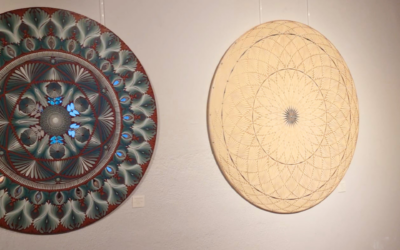
It had all started quite unspectacularly: I was asked whether I could imagine exhibiting my pictures at the Simon-Petrus Church in Hamburg-Poppenbüttel. The church building no longer has an active congregation — though it has not been deconsecrated; weddings, for example, still take place there. The Friends of the Simon-Petrus Church, a voluntary organisation that grew out of this very congregation, has been keeping the building alive for the past year: with concerts, readings and exhibitions.
I was immediately taken with the idea of being able to exhibit there. The building is utterly unusual, with glass blocks in a variety of colours that allow light to flood into the room in a way that changes constantly throughout the day. When I first stood inside, I thought: how beautifully this complements the mandalas.
But back to the discussion: I had to pause for a moment when I heard about it. Not because the question of whether mandalas are even Christian had offended me, but because it got me thinking. Because it has a depth that deserves a good blog post.
Taking the question seriously
And somehow I really liked the question. I mean that without any irony. Because questions asked out of genuine conviction deserve to be engaged with — not dismissed out of hand.
However, the word ‘Christian’ can have two meanings in this sentence, and it is worth examining this in more detail.
Firstly: that it has Christian origins. The answer here is clear and straightforward — no. The word ‘mandala’ comes from Sanskrit, and the practice stems from Hindu and Buddhist traditions. This has never been in doubt, and it would not be a criticism, but simply a fact.
The second possible meaning: being at odds with the Christian faith. And that is certainly the real issue at stake here. In Tantric Buddhism, the mandala is, in fact, a spiritual tool with a very specific religious function: an object of meditation aimed at a particular experience of the divine. Anyone who removes it from this context, the argument goes, may be taking on more than they intended.
This is a case for being mindful, for thinking carefully about what we surround ourselves with. And I fully agree with this sentiment: things should not be adopted without a second thought.
It’s just that when I look at history — and at what the circle itself represents, long before any religion came into being — the picture looks rather different.
What the word reveals
Let’s start with the word. ‘Mandala’ comes from Sanskrit — the ancient Indian language of scholarship — and simply means ‘circle’. There is no ritual, no deity, no creed inherent in the word itself. Just the oldest geometric shape known to humankind.
Circular images with a distinct centre appear in archaeological finds from the Palaeolithic era — estimated to be between 25,000 and 30,000 years old. Long before Hinduism or Buddhism existed. Long before there were churches. Humans have produced this image time and again, across a wide variety of cultures, independently of one another.
The circle has always been part of the church
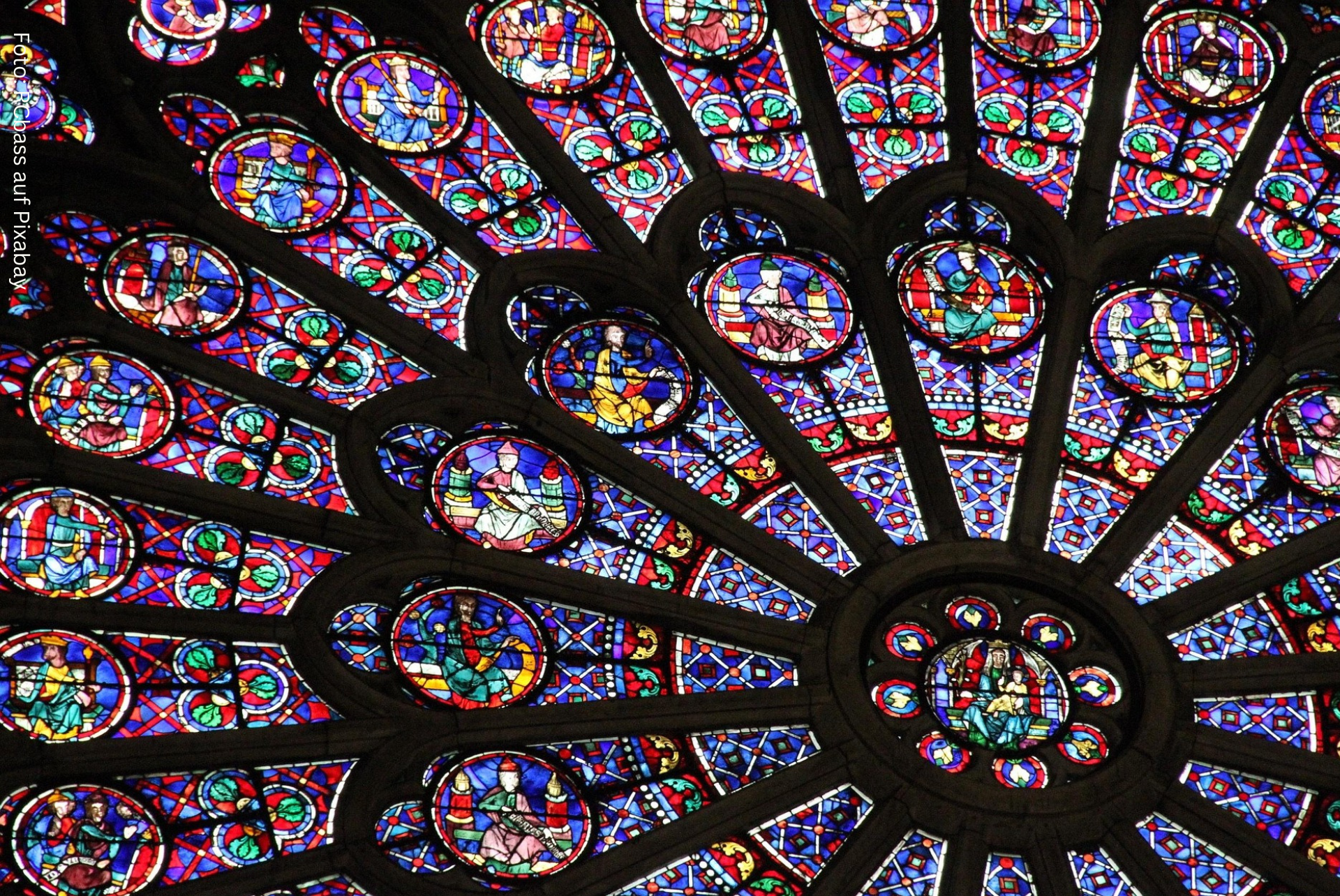
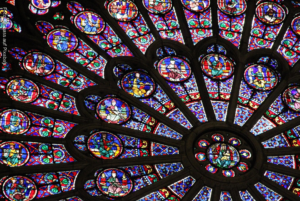
The next time you step inside a Gothic cathedral, you should look up — at the rose window above the portal. Notre-Dame in Chartres. Notre-Dame in Paris. Strasbourg Cathedral. Magnificent circular windows, with diameters of over 13 metres, arranged concentrically and centred on a single point. (Wikipedia: Rose window)
Art historians describe their effect as follows: soothing, harmonious, meditative. They can embody the perfection of the divine love that radiates in all directions. This is not an esoteric interpretation. It is stated in every art history book.
These rose windows were created from the 11th century onwards — and they follow exactly the same principle as a mandala: a centre from which order unfolds outwards. Symmetry. Concentration. An invitation to focus one’s gaze and find peace.
The circle as a spiritual form is not something imported from the East to the West. It has been carved in stone and etched in glass in Europe for centuries. It is as much a part of the Church as it is of Buddhism — because, on closer inspection, it does not belong to any one tradition alone.
What researchers say
In his book *Mandala – In Search of Enlightenment* (Arnoldsche Verlagsanstalt), the author and photographer Peter van Ham has compared the symbolism of circles across all religions and cultures — from Mexico to Kathmandu, and from Buddhism through Christianity to Islam. An interview on this subject appeared on evangelisch.de, the news portal of the Protestant Church — in other words, on a platform that is anything but indifferent to the issue.
Van Ham says there: “In its original Sanskrit meaning, ‘mandala’ simply means ‘circle’. Drawing a circle was, and still is today, regarded in a spiritual context as a means of centring oneself and focusing one’s concentration. As my research has shown, this can be found in all of humanity’s spiritual traditions.”
And he draws a comparison that moved me: a Christian monstrance containing the Host, a Buddhist Wheel of Dharma, and an archaic Chinese disc symbolising the afterlife — all circular, all with a point-like centre as the seat of all-encompassing truth. All three suggest that there is a transcendence beyond purely physical existence — and thus convey a message that fosters deep understanding between peoples.
Three cultures. Three millennia. The same gesture.
What matters to me
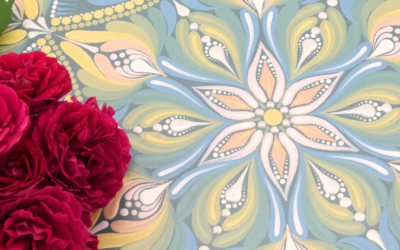
My mandalas do not convey any religious doctrine. No creed, no deity, no teaching. They are created in silence — to the rhythm of the drawing tool, dot by dot, stroke by stroke — out of a desire to create something that brings calm to a space. Both literally and figuratively.
I believe that paintings can have an effect. That a mandala on the wall — through its symmetry, its centre, its colour scheme — speaks to something within a person that words cannot reach. Something that cannot be explained, but can be felt.
I have described in more detail what happens within a person during this process — and what role protection and transformation play in this ancient form — in this article.
How this relates to spirituality is something I have described elsewhere: as breath — not as a technique or a sense of belonging, but as what arises when one truly pauses.
Whether it happens in a living room, an office or a church that is currently finding its way again — the form, the intention and the effect remain the same.
Conclusion: the circle belongs to everyone
The discussion that took place regarding my exhibition ultimately reached a clear conclusion: the pictures were allowed to be displayed. The exhibition went ahead.
Looking back, what moves me most about it is not the outcome. It is the fact that the question was asked — seriously, out of genuine concern for what this place means. That is not backwardness.
Perhaps the deepest common ground between art and faith lies precisely in this: that both are searching for a centre. Not necessarily the same one. Not by the same means. But with the same earnestness.
The circle was already present in cathedrals long before the word ‘mandala’ reached Europe. It appears in sand drawings, in church windows and on canvases. It does not belong to any one tradition alone.
Anyway, this question kept me thinking for a while — longer than the exhibition lasted. I’m curious to hear what you think about it.

0 Comments